Public Land Debate: State Takeover Remains an Unpopular, Unworkable Idea

Public Land43
Over the last few years, a small group of politicians and ideological activists have been promoting the idea that national forests and other public lands should be handed over to state management. Their efforts attracted attention last winter, when the Malheur National Wildlife Refuge was taken over by a group of armed activists who also called for all wildlife refuges, national forests, and other public lands to be transferred to states and sold off for private development.

Last week, MWF Executive Director Dave Chadwick was invited to participate in a debate over public land management with Ken Ivory, a state legislator from Utah who advocates the state takeover of public lands.

The debate spotlighted yet again the many reasons why handing national lands to state management is a fundamentally flawed, unworkable idea.

In calling for the state takeover, Ivory harshly criticized national public lands and suggested that national forests need to be managed like backyard gardens. He recommended that the federal government revive nineteenth century land disposal policies and transfer national public lands to state control. Under state management, these lands could be used to maximize revenue from oil drilling, logging, and mining in order to balance state budgets.

Offering a defense of national public lands, Chadwick focused on the many benefits that public lands provide for wildlife habitat, outdoor recreation, and the economy. He cited data on the economic benefits produced by both resource development and outdoor recreation on public lands. Finally, he noted the overwhelming public support for protecting public lands for all Americans and opposition to transferring lands to state management.

We’ve known for a long time that the state takeover of public lands would cut off public access and ruin wildlife habitat. Rejecting the multiple-use approach to public land management would be bad for hunters, anglers, hikers, bikers, and every other public land user. Budget realities would force states to manage lands for maximum revenue and ultimately sell them off.

In addition to being a bad idea, last week’s debate confirmed that the state takeover of public land is also completely unworkable. The whole concept is full of unanswered questions, empty promises, and speculative assumptions. During the 90 minute discussion, Mr. Ivory couldn’t answer the most basic questions from the audience about how state transfer or management would actually work, even if it were a good idea.

The state takeover of public lands has received more than its fair share of attention over the last few years – and it has been thoroughly rejected by the democratic process. It continues to move forward only because of the efforts of well-funded ideological lobbyists and headline-grabbing incidents like the takeover of Malheur National Wildlife Refuge.

Public land management is a complex issue that merits thoughtful action and bipartisan agreement. Reforming wildfire funding, supporting local collaboration, expediting timber harvesting and restoration to improve forest health, and fully funding federal land protection programs are all ideas that enjoy bipartisan support. Speculative philosophical debates about state management of national public lands do a disservice to the American people.

It’s Time for Everyone to Pay for Wildlife Management

redrockslakenationalwildliferefugeusfishwildlifeservice
It’s hard for most of us to imagine a time when hunting and fishing were completely unregulated. Setting up wildlife management agencies to implement science-based management and habitat protection was really the first step in the wildlife conservation movement at the start of the 20th century.

With strong support from hunters and anglers, wildlife management was set up to be funded by hunting and fishing licenses. This “user-pays” model, in which hunters and anglers paid license fees to support conservation of the resources they loved, was a truly remarkable innovation in paying for government services – and the last century has shown that it is also a wild success.

Today, we enjoy an abundance of fish and wildlife that was unimaginable a century ago. These resources support the best hunting, fishing, and wildlife-watching in the world, generating billions of dollars a year in economic activity and supporting hundreds of thousands of jobs.

At the same time, the challenges facing wildlife and habitat are getting tougher. As our communities grow, we’re taking up more and more of the lands and waters that wildlife depend on for survival. The spread of invasive species and diseases poses a constant threat to wildlife populations. Working with private landowners to protect habitat is essential, but it takes time. Wildlife conservation is getting more and more expensive, but funding continues to depend only on hunters and anglers buying annual licenses.

Perhaps most important, we’re now realizing that all Montanans benefit from our state’s fish and wildlife, but many of them never purchase a hunting or fishing license. Wildlife management shouldn’t be paid for only by sportsmen. Everyone who benefits from our fish and wildlife should help shoulder the burden.  That means we need to broaden how we pay for wildlife management beyond just hunting and fishing licenses.

A few states have already expanded conservation funding beyond just hunters and anglers. In Missouri and Arkansas, wildlife management has been funded for decades primarily from a dedicated portion of their state sales taxes. A similar effort is underway in Iowa. Other states have found ways to supplement license dollars with lottery revenue, real estate taxes, and other sources of funding that more of the public can pay into.

The experiences in Arkansas and Missouri also show us that moving away from a sole dependence on license revenue has strengthened, not weakened,  scientific wildlife management and hunting heritage. When all citizens chip in for conservation, hunting and fishing grow in importance as valued traditions and proven wildlife management tools – and not just revenue sources.

In considering ways to broaden how we pay for wildlife management, we are standing on the shoulders of giants – the first generation of  hunters and anglers who, a century ago, invented the conservation movement. Today, we have an opportunity to carry on that legacy. By involving all Montanans in paying for wildlife conservation, we can ensure that our wildlife resources and hunting and fishing traditions endure for future generations.

Dave Chadwick is the Executive Director of the Montana Wildlife Federation.  Contact him at dchadwick@mtwf.org

Fight Invasive Species: Inspect, Clean and Dry

DSC_3152
Boating season is here; time to remember to help fight aquatic invasive species — non-native plants and animals that can cause harm to our waterways and fishing.

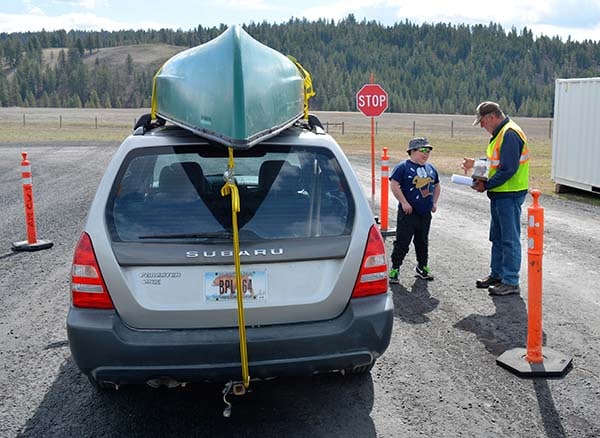
Yesterday I took my son, Cory to the Seeley-Swan valley to canoe and fish. On the way, we stopped at a mandatory boat check station run by the Montana Department of Fish, Wildlife and Parks (FWP).

It was a good reminder about invasive plants, such as Eurasion watermilfoil, and invasive animals, such as zebra and quagga muscles, that can have severe and negative impacts to our native fisheries. These invasives can “hitchhike” their way from one waterway to another on our boats, waders and other fishing gear.

The stop was very educational, with the main message being: Do your part to stop aquatic hitchhikers: Inspect. Clean. Dry. (Keep your boat and gear clean and free of debris; remove all mud, water and plants; and let your boat completely dry before using it in other waters.

The good, friendly folks from FWP gave us some informative brochures, a sponge to clean my boat with, and showed my son and I some actual zebra mussels so we know what they look like.

Help protect our lakes, rivers, streams and our exceptional fisheries! To learn more, check out: http://fwp.mt.gov/fishAndWildlife/species/ais/

Dave Stalling is Montana Wildlife Federation’s Western Field Rep. You can reach him at dstalling@mtwf.org.

Elk Shoulder Seasons Approved by FWP

Elk standing in field - Skip Kowalski - Dec 2013 Photo Courtesy of Skip Kowalski

Now that the dust has settled and elk “shoulder seasons” have been approved by the Montana Fish and Wildlife Commission, it’s time to step back and look at what it means for the future of hunting in the Treasure State. The commission in February approved these additional elk seasons in 43 hunting districts throughout the state in an effort to address populations that are over the targeted objective laid out in the statewide elk management plan.

That decision came after a process that was well over a year in the works, with more than a dozen Montana Fish, Wildlife and Parks biologists, game wardens and other officials meeting to craft a proposal to address overpopulated elk herds. And it followed a bill in the 2015 Legislature, SB 245, sponsored by Sen. Doug Kary, R-Billings, that would have written the opportunity for late hunting seasons into state law. The bill was vetoed by Gov. Steve Bullock, but in his veto statement he said FWP was working on alternatives to address elk management.

First off, what is a shoulder season, and how is it different than the game damage and management seasons that FWP was already using?

A shoulder season is a rifle hunting season that is established outside of the regular five-week general season and is printed in the hunting regulations. They cover entire hunting districts and can include additional permits, or use general licenses, as well as second cow elk “B” tags. They can start as early as August 15 and run as late as February 15.

In comparison, game damage and management hunts are held on a smaller scale, down to an individual ranch, to address either a point-source issue on a particular property as well as an elk population that is over objective. They happen through a process laid out in state law as well as in state administrative rules set by Montana FWP. They are smaller scale, and have eligibility requirements that include some level of reasonable public access during the general hunting season for landowners to qualify.

That’s important, because the five-week season is Montana’s time-tested method of managing our wildlife populations. It has worked for decades. And the law that requires that was requested more than two decades ago by lawmakers who saw what happens when some properties receive no hunting pressure throughout the general season.

MWF supports private property rights, and it is every landowner’s decision whom to allow to hunt on their land. But those decisions on hunter access can have major implications for wildlife management that can lead to adverse effects on their neighbors. Solid research has shown that elk learn where refuges with no or very little hunting pressure are. And once they do, other elk follow.

These areas are incredibly difficult for professional wildlife managers to deal with. With that knowledge, FWP worked to craft a proposal that creates incentives for landowners to allow enough hunting during the general rifle season to affect elk numbers, as well as to help redistribute them on the landscape. That’s key, because quality hunting and better wildlife management are dependent on spreading out hunters, as well as spreading out wildlife.

The elk shoulder seasons aren’t just extra seasons. They’re called “performance based” shoulder seasons and that performance is based on guidelines the Commission adopted in October. They’re meant to make the shoulder seasons more effective, and prevent them from becoming the old late elk seasons, which were ineffective at controlling elk numbers. Those seasons in many areas actually lead to growing elk herds, despite the length of the season running into mid-February.

The guidelines state clearly that the shoulder seasons are meant to supplement general season harvest and not replace it. Here they are, with an explanation of each:

1. The harvest of bull elk for three years during the archery and general seasons must reach half of the bull recruitment during the same time.
2. The number of cow elk killed during the archery and general seasons must also be half of the total number of cow elk recruited into the population.
3. The total number of cow elk harvested for all seasons combined, including the extended shoulder seasons, must be greater than the recruitment of new cow into a district’s population.
4. The three year harvest of all elk for all seasons combined must exceed the total number of elk recruited to a population.

The guidelines also lay out exceptions that allow for shoulder seasons in areas where hunters, landowners and FWP have worked together to reach agreement. But it is important that those are kept to a minimum.

Why are the guidelines so important? They ensure that Montana keeps its focus for harvest on our general season, to promote the democracy of hunting. This is when everyone has an equal chance to hunt elk. It’s when Montanans and their out of state guests schedule week-long hunting trips. And biologically, it’s the most ethical time of year to be harvesting elk, because cows aren’t far along in their pregnancies and calves can survive on their own.

Hunting pressure on elk in valley bottoms during the general season can help push them back to higher elevations on public land. That will help make for better elk hunting for everyone.

MWF will be monitoring the harvest data from these shoulder season hunts to ensure that FWP is sticking to the guidelines. If a district doesn’t meet the criteria, the shoulder seasons need to go away. We will be working to ensure FWP sticks with the guidelines as it works to improve elk management.

With the help of our friends and neighbors in the farming and ranching community, we can make these seasons a success and bring elk numbers back down to the objective population.

Stay tuned. Please feel free to provide feedback to Nick Gevock, MWF conservation director, as well as FWP biologists in your areas around the state.

Nick Gevock is Montana Wildlife Federation’s Conservation Director. You can send him questions or comments at ngevock@mtwf.org.

Most Montana Bighorn Herds at Risk

USGS_ovis_canadensis_GNP_bighorn_rams_0 Credit: U.S. Geological Survey. Photo By: Kim Keating
The National Wildlife Federation and partnering wildlife groups say the future of bighorn restoration depends on reducing the risk of disease by reaching agreements with sheep ranchers. With 39 of 46 Montana bighorn sheep herds at risk of disease passed from domestic sheep, this problem is the main obstacle to future restoration.

Contact between domestic and bighorn sheep exposes wild sheep to bacteria carried by outwardly healthy domestic sheep; these bacteria cause pneumonia, typically lethal to bighorn sheep.

While several factors influence bighorn sheep restoration, pneumonia is widely considered the most important limiting factor. Pneumonia outbreaks have the potential to cause 30-90% mortality of a bighorn population. Additional outbreaks continue to occur within a herd several years after the initial outbreak, affecting lamb survival. Once a herd is exposed to pneumonia, it is often continually affected, making it extremely difficult for the population to recover, much less thrive.

“We need to do more to protect bighorn herds from respiratory disease because population recovery is so much harder after a pneumonia outbreak,” said Tom France, Regional Executive Director for the National Wildlife Federation in Missoula.

The solution highlighted in the report is for hunters and other wildlife conservationists to work collaboratively with domestic sheep producers to reduce risk of contact. The report “Challenges and Opportunities for Bighorn Sheep Conservation in Montana” takes the first step toward doing that by identifying domestic sheep flocks within 20 miles of established bighorn sheep herds in the Big Sky State.

The risks are real. Last year, pneumonia outbreaks caused significant die-offs among bighorns near Paradise and Gardiner. Twenty-six bighorn herds in Montana experienced large die-offs between 1984 and 2015, with more than half of these die-offs occurring in the past decade.

“During winter 2009-2010 pneumonia outbreaks in the West, Montana bighorns took the biggest hit of any western state or province, losing an estimated 20% of our statewide total,” said Brian Solan of Helena, president of the Montana Wild Sheep Foundation. “In addition, many of those herds have not rebounded from that disease event and have continued to struggle with lamb recruitment almost seven years later.”

The worst-case scenario is playing out in the Tendoy Mountains of southwestern Montana, where a once-thriving bighorn herd has never recovered from a pneumonia outbreak in the 1990s. Via hunter harvest, followed by agency removal, Montana Fish, Wildlife, and Parks (FWP) managers are currently eliminating Tendoy bighorn sheep which still carry the disease, inhibiting population recovery. Once infected bighorns have been completely removed from the Tendoy Mountains, FWP’s goal is to start a new herd by introducing disease-free bighorns.

“Our mission is to put and keep sheep on the mountain, which means raising and spending millions of dollars of private money to translocate sheep, and trying to keep them healthy following release,” said Kevin Hurley, conservation director of the Bozeman-based Wild Sheep Foundation Conservation. “In putting and keeping sheep on the mountain, the Wild Sheep Foundation works closely with wildlife managers, domestic sheep producers, and sportsmen stakeholders.”

While there is no simple solution suitable to all situations, the wildlife groups urge increased awareness of the risk to bighorns, increased collaboration with producers and a multi-faceted effort to keep bighorns and domestic sheep separated in time and space.

“The good news is that win-win solutions exist that will make bighorns more secure; separation is the key,” France says. “We need to work together to keep wild and domestic sheep separated, or we risk one bighorn die-off after another.”

“Bighorn sheep are a symbol of Montana’s wild heritage, treasured by hunters and all Montanans,” said Kathy Hadley, president of the Montana Wildlife Federation. “This report lays out some of the key issues surrounding bighorn sheep restoration around the Treasure State. Tt also shows the importance of finding ways to work together with landowners who have domestic sheep if we’re going to restore bighorns into their historic ranges, grow their numbers and ultimately build more hunting opportunity for this incredible species.”

You can read the full report via National Wildlife Federation’s website Bighorns Big Risks

Jeff Lukas – MWF Elk Campaign Manager

Jeff Lukas

Conservation Director

Jeff Lukas is a passionate conservationist who has been fishing and hunting his entire life. Whether it’s floating a small stream chasing trout, pursuing elk in the high country, or waiting in a blind for ducks to set their wings, Jeff is always trying to bring more people afield to show them what we are trying to protect. He loves being in the arena, and he will never shy away from conversations about the beautiful and unique corners of Big Sky country.