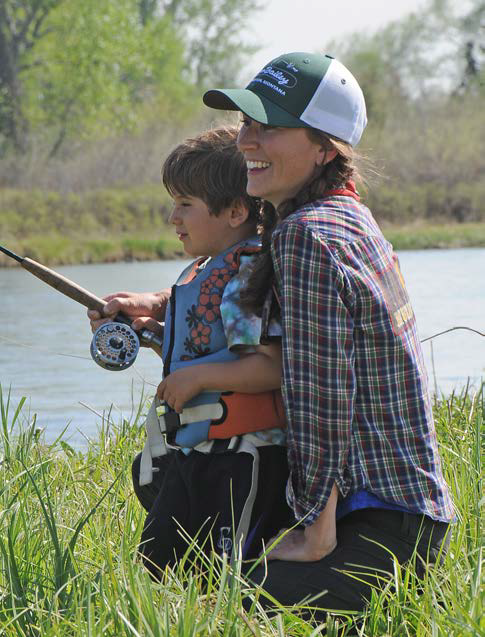
Photo Credit: David Stalling & son fishing for trout within the proposed recreation area of the BCSP
The Montana Wildlife Federation applauds today’s decision by the Montana Fish and Wildlife Commission to support the Blackfoot Clearwater Stewardship Project (BCSP). The five-member, governor-appointed citizen committee, which oversees the Montana Department of Fish, Wildlife and Parks, voted unanimously today to approve a resolution endorsing the effort.
“The commission’s support recognizes the value of this cooperative project for Montana’s fish and wildlife, and hunting and angling heritage,” says Kathy Hadley, president of MWF. “It’s a great example of local citizens coming together to reach balanced compromises that protect and enhance healthy forests, fish, wildlife, hunting, angling, other recreation, jobs and traditional Montana values.”
The BCSP is made up of a variety of individuals and organizations of diverse backgrounds – including ranchers, loggers, hunters, anglers, county commissioners, snowmobilers and environmentalists – to shape the management of our public lands in and around the Seeley-Swan Valley. MWF is a partner and strong supporter of the project.
“By working together, we are cutting through much of the divisive, partisan rhetoric that shapes so much of our public lands management today,” says Mack Long, a hunter, guide and owner of Bob Marshall Wilderness Outfitters, “and showing that we, the people on the ground, can achieve workable and viable solutions.”
Project partners are urging Montana’s Congressional delegation to introduce legislation to approve and implement the BCSP.
In April, the US Senate narrowly defeated an amendment to block efforts by the US Environmental Protection Agency (EPA) and US Army Corps of Engineers to clarify the Clean Water Act and protect isolated wetlands and headwater streams. The amendment, by Senator John Hoeven (North Dakota) would prevent the EPA from implementing the Waters of the US rule. This rule was developed after a decade of work to clean up confusion over the application of the Clean Water Act.
“Montana’s streams and wetlands are crucial to our hunting and fishing heritage” said Dave Chadwick, executive director of the Montana Wildlife Federation. “They also support our economy, by providing the habitat for fish and wildlife that drives $1.4 billion in annual economic activity based on hunting and fishing.”
Senator Hoeven’s amendment did not receive the 60 notes needed to pass the Senate. Montana’s senior Senator Jon Tester voted against the amendment and in support of Clean Water. Senator Steve Daines voted for the amendment.
“We are grateful to Senator Tester for standing up for Montana and voting against this short-sighted amendment” said Chadwick. “Montanans are fortunate to have a senator who sees through the political rhetoric and supports the common-sense protections for the streams and wetlands that are so crucial to our state’s outdoor economy.”
The Waters of the US rule is fair, clear, and based on the best science. The rule defines the situations when the law does and does not apply, providing consistency for landowners and developers. it also includes extensive exemptions for agricultural activities. The EPA’s independent Science Advisory Board reviewed the rule and found it to be scientifically and technically accurate.
“Montana’s streams and wetlands need this common-sense, science-based rule to protect habitat and provide certainty for developers. Churning up confusion and taking potshots to score political points belittles the importance of headwaters streams and wetlands to Montana’s economy” said Dan Vermillion, a fishing guide and owner of Sweetwater Travel in Livingston, Montana.
In addition to the wildlife habitat values, approximately 54% of Montana’s population uses public drinking water systems that rely on clean surface water. When those waters are degraded, it dramatically increases the costs of treating that water. That’s a cost borne by taxpayers.
A bipartisan poll conducted last summer by the National Wildlife Federation found that more than 8 in 10 of the hunters and anglers (83 percent) supported the application of the Clean Water Act to headwater streams and wetlands. 82 percent agreed with the statement: “We can protect our water quality and have a strong economy with good jobs for Americans at the same time, without having to choose one over the other” and 67 percent said they would have a more favorable opinion if their senator upheld the Waters of the US rule.
On May 3, Interior Secretary Sally Jewell will be joining Senator Jon Tester here in Helena to talk about our public land legacy. MWF’s own Chris Marchion will also be making some remarks.
We’re excited that Secretary Jewell will be in Montana, where we have done so much to protect our public lands, our hunting and fishing heritage, and our outdoor economy.
I hope you can join us in turning out a good crowd! The event will begin at 10:30 AM, and it will take place at the Devil’s Elbow Campground on Hauser Lake – about 15 minutes from Helena.
It’s an easy drive to get there: just take York Road to Lakeside, then drive another 2.2 miles to the campground.
If you need any additional information, don’t hesitate to contact the MWF office at mwf@mtwf.org or 406-458-0227.
Photo Credit: Alexis Bonogofsky photo of Tongue River Valley
After decades of protest from ranchers, sportsmen, and conservationists, the Surface Transportation Board just denied the permit for the proposed Tongue River Railroad. The TRR would have fragmented some of the best wildlife habitat in the state to ship Montana coal to Asia.
The Surface Transportation Board decided to “deny TRRC’s request to hold this proceeding in abeyance and instead dismiss the proceeding without prejudice. At this time, there appears to be little prospect that Otter Creek Coal’s mine permit will be secured in the foreseeable future. Otter Creek Coal and its parent, Arch, have both filed for bankruptcy, and Otter Creek Coal has suspended its application for an MDEQ mining permit indefinitely.”
This is another huge victory in protecting the Tongue River Valley from development. This agricultural valley provides ranchers and farmers the ability to carry on the traditions of past generations. The Tongue River Valley also provides some of the best habitat in the country, with pheasants, pronghorn, and trophy mule deer calling the valley home. Hunters and anglers should rejoice to know that this valley will continue to be a paradise, where future generations will be able to wet their lines and chase game.
Over the last few years, a small group of politicians and ideological activists have been promoting the idea that national forests and other public lands should be handed over to state management. Their efforts attracted attention last winter, when the Malheur National Wildlife Refuge was taken over by a group of armed activists who also called for all wildlife refuges, national forests, and other public lands to be transferred to states and sold off for private development.
Last week, MWF Executive Director Dave Chadwick was invited to participate in a debate over public land management with Ken Ivory, a state legislator from Utah who advocates the state takeover of public lands.
The debate spotlighted yet again the many reasons why handing national lands to state management is a fundamentally flawed, unworkable idea.
In calling for the state takeover, Ivory harshly criticized national public lands and suggested that national forests need to be managed like backyard gardens. He recommended that the federal government revive nineteenth century land disposal policies and transfer national public lands to state control. Under state management, these lands could be used to maximize revenue from oil drilling, logging, and mining in order to balance state budgets.
Offering a defense of national public lands, Chadwick focused on the many benefits that public lands provide for wildlife habitat, outdoor recreation, and the economy. He cited data on the economic benefits produced by both resource development and outdoor recreation on public lands. Finally, he noted the overwhelming public support for protecting public lands for all Americans and opposition to transferring lands to state management.
We’ve known for a long time that the state takeover of public lands would cut off public access and ruin wildlife habitat. Rejecting the multiple-use approach to public land management would be bad for hunters, anglers, hikers, bikers, and every other public land user. Budget realities would force states to manage lands for maximum revenue and ultimately sell them off.
In addition to being a bad idea, last week’s debate confirmed that the state takeover of public land is also completely unworkable. The whole concept is full of unanswered questions, empty promises, and speculative assumptions. During the 90 minute discussion, Mr. Ivory couldn’t answer the most basic questions from the audience about how state transfer or management would actually work, even if it were a good idea.
The state takeover of public lands has received more than its fair share of attention over the last few years – and it has been thoroughly rejected by the democratic process. It continues to move forward only because of the efforts of well-funded ideological lobbyists and headline-grabbing incidents like the takeover of Malheur National Wildlife Refuge.
Public land management is a complex issue that merits thoughtful action and bipartisan agreement. Reforming wildfire funding, supporting local collaboration, expediting timber harvesting and restoration to improve forest health, and fully funding federal land protection programs are all ideas that enjoy bipartisan support. Speculative philosophical debates about state management of national public lands do a disservice to the American people.
Jeff Lukas
Conservation Director
Jeff Lukas is a passionate conservationist who has been fishing and hunting his entire life. Whether it’s floating a small stream chasing trout, pursuing elk in the high country, or waiting in a blind for ducks to set their wings, Jeff is always trying to bring more people afield to show them what we are trying to protect. He loves being in the arena, and he will never shy away from conversations about the beautiful and unique corners of Big Sky country.