National Forest lands are vitally important not only to hunters, but to all Montanans and all Americans. They’re essential for wildlife, fish, clean water and ultimately to a high quality of life. That’s why it’s so troubling that the U.S. Forest Service is proposing severe cuts to the trails budget for the agency’s Region 1, which is based in Missoula and covers national forests in Montana, northern Idaho and the Dakotas.
The proposal in a nutshell would base funding for trail maintenance on a formula that considers user days. That might sound logical, but it’s not a good measure of the trail maintenance needs of a region or particular forest. And it would result in a 30 percent reduction in trail funding for Montana’s national forests over the next three years. That’s a drastic cut that would have devastating effects for the condition of our trails, and ultimately for public access to enjoy these lands for hunting, fishing, hiking and numerous other activities.
We simply cannot absorb those kind of cuts. It would not only hurt our access and quality of life, it would also hurt Montana’s huge – and growing – outdoor tourism economy, which currently generates $5.8 billion in economic activity and supports 64,000 jobs.
Everybody understands that we need to make some hard choices in government. Federal money isn’t flowing and we need to look for strategic places to save money. We also need to take a look at the way money is being spent.
But this isn’t an area to make cuts. And this isn’t just about Montanans. People from all over the country and the world come to the Treasure State to enjoy some of the most incredible landscapes on earth. These trails are essential to that.
The Montana Wildlife Federation recently wrote to both of Montana’s U.S. Senators, as well as Forest Service Chief Tom Tidwell to express our concerns over the proposed cuts. We called for a look at other options and ultimately for proper funding for our trail system.
Fortunately, both Sens. Jon Tester and Steve Daines have spoken out against the new formula, and called for the agency to look at changes that doesn’t hit Region 1 so hard. Montana hunters, anglers and recreationists should weigh in as well.
Nick Gevock is the conservation director for the Montana Wildlife Federation.
It’s hard for most of us to imagine a time when hunting and fishing were completely unregulated. Setting up wildlife management agencies to implement science-based management and habitat protection was really the first step in the wildlife conservation movement at the start of the 20th century.
With strong support from hunters and anglers, wildlife management was set up to be funded by hunting and fishing licenses. This “user-pays” model, in which hunters and anglers paid license fees to support conservation of the resources they loved, was a truly remarkable innovation in paying for government services – and the last century has shown that it is also a wild success.
Today, we enjoy an abundance of fish and wildlife that was unimaginable a century ago. These resources support the best hunting, fishing, and wildlife-watching in the world, generating billions of dollars a year in economic activity and supporting hundreds of thousands of jobs.
At the same time, the challenges facing wildlife and habitat are getting tougher. As our communities grow, we’re taking up more and more of the lands and waters that wildlife depend on for survival. The spread of invasive species and diseases poses a constant threat to wildlife populations. Working with private landowners to protect habitat is essential, but it takes time. Wildlife conservation is getting more and more expensive, but funding continues to depend only on hunters and anglers buying annual licenses.
Perhaps most important, we’re now realizing that all Montanans benefit from our state’s fish and wildlife, but many of them never purchase a hunting or fishing license. Wildlife management shouldn’t be paid for only by sportsmen. Everyone who benefits from our fish and wildlife should help shoulder the burden. That means we need to broaden how we pay for wildlife management beyond just hunting and fishing licenses.
A few states have already expanded conservation funding beyond just hunters and anglers. In Missouri and Arkansas, wildlife management has been funded for decades primarily from a dedicated portion of their state sales taxes. A similar effort is underway in Iowa. Other states have found ways to supplement license dollars with lottery revenue, real estate taxes, and other sources of funding that more of the public can pay into.
The experiences in Arkansas and Missouri also show us that moving away from a sole dependence on license revenue has strengthened, not weakened, scientific wildlife management and hunting heritage. When all citizens chip in for conservation, hunting and fishing grow in importance as valued traditions and proven wildlife management tools – and not just revenue sources.
In considering ways to broaden how we pay for wildlife management, we are standing on the shoulders of giants – the first generation of hunters and anglers who, a century ago, invented the conservation movement. Today, we have an opportunity to carry on that legacy. By involving all Montanans in paying for wildlife conservation, we can ensure that our wildlife resources and hunting and fishing traditions endure for future generations.
Dave Chadwick is the Executive Director of the Montana Wildlife Federation. Contact him at dchadwick@mtwf.org
The Bureau of Land Management (BLM) has decided against a land exchange that would have resulted in the loss of public land known as the Durfee Hills. Billionaire brothers Dan and Farris Wilks were proposing to exchange their Anchor Ranch, which sits just north of the Missouri River in Blaine County, along with other lands, for the Durfee Hills, a landlocked parcel of BLM property which sits inside the Wilks’ NBar Ranch in Fergus County.
MWF had opposed the land transfer on the grounds that it was not a fair value trade. To lose Durfee Hills would have resulted in the loss of some of the best elk habitat in the state. The Wilks contended the land trade would open the Bullwhacker Road as access to the Upper Missouri River Breaks National Monument south of Anchor Ranch. However, that area is already accessible by boat on the river and from roads farther upstream. MWF believes that by partnering with sportsmen and other conservation groups, it can increase access to the monument without giving up public lands such as the Durfee Hills.
The victory can be attributed to local sportsmen of the Central Montana Outdoor group, along with the help of the MWF, both of whom worked tirelessly to stop the transfer. Doug Krings, speaking on behalf of Central Montana Outdoors said “you only get to keep what you are willing to fight for.”
Mark Albers, BLM’s Central Montana District Manager, said that the decision against pursuing the transfer was a result of competing priorities.
The Durfee Hills is one of many important BLM-managed lands in central Montana that rovide unequalled habitat for everything from sage grouse to trophy bull elk and are available for the public to enjoy. The value of this landscape to Montanans stems from its habitat which provides for world-class diversity and healthy populations of wildlife.
The BLM is currently working on a Resource Management Plan for the Lewistown area. As the BLM’s Lewistown Field Office prepares its draft Resource Management Plan, we as sportsmen and conservationists must ensure that the BLM recognizes this opportunity to protect these lands for their habitat and wildlife value. The BLM will be accepting public comment when the draft is released; it is our duty to tell them to protect this valuable habitat for us and future generations to enjoy.
John Bradley is Montana Wildlife Federation’s Eastern Field Representative. You can send him questions or comments at jbradley@mtwf.org.
Boating season is here; time to remember to help fight aquatic invasive species — non-native plants and animals that can cause harm to our waterways and fishing.
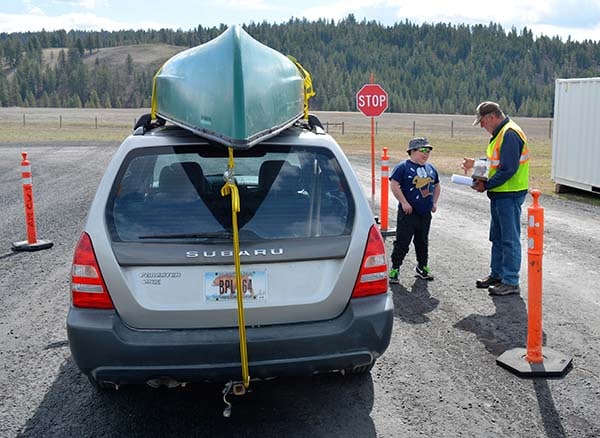
Yesterday I took my son, Cory to the Seeley-Swan valley to canoe and fish. On the way, we stopped at a mandatory boat check station run by the Montana Department of Fish, Wildlife and Parks (FWP).
It was a good reminder about invasive plants, such as Eurasion watermilfoil, and invasive animals, such as zebra and quagga muscles, that can have severe and negative impacts to our native fisheries. These invasives can “hitchhike” their way from one waterway to another on our boats, waders and other fishing gear.
The stop was very educational, with the main message being: Do your part to stop aquatic hitchhikers: Inspect. Clean. Dry. (Keep your boat and gear clean and free of debris; remove all mud, water and plants; and let your boat completely dry before using it in other waters.
The good, friendly folks from FWP gave us some informative brochures, a sponge to clean my boat with, and showed my son and I some actual zebra mussels so we know what they look like.
Now that the dust has settled and elk “shoulder seasons” have been approved by the Montana Fish and Wildlife Commission, it’s time to step back and look at what it means for the future of hunting in the Treasure State. The commission in February approved these additional elk seasons in 43 hunting districts throughout the state in an effort to address populations that are over the targeted objective laid out in the statewide elk management plan.
That decision came after a process that was well over a year in the works, with more than a dozen Montana Fish, Wildlife and Parks biologists, game wardens and other officials meeting to craft a proposal to address overpopulated elk herds. And it followed a bill in the 2015 Legislature, SB 245, sponsored by Sen. Doug Kary, R-Billings, that would have written the opportunity for late hunting seasons into state law. The bill was vetoed by Gov. Steve Bullock, but in his veto statement he said FWP was working on alternatives to address elk management.
First off, what is a shoulder season, and how is it different than the game damage and management seasons that FWP was already using?
A shoulder season is a rifle hunting season that is established outside of the regular five-week general season and is printed in the hunting regulations. They cover entire hunting districts and can include additional permits, or use general licenses, as well as second cow elk “B” tags. They can start as early as August 15 and run as late as February 15.
In comparison, game damage and management hunts are held on a smaller scale, down to an individual ranch, to address either a point-source issue on a particular property as well as an elk population that is over objective. They happen through a process laid out in state law as well as in state administrative rules set by Montana FWP. They are smaller scale, and have eligibility requirements that include some level of reasonable public access during the general hunting season for landowners to qualify.
That’s important, because the five-week season is Montana’s time-tested method of managing our wildlife populations. It has worked for decades. And the law that requires that was requested more than two decades ago by lawmakers who saw what happens when some properties receive no hunting pressure throughout the general season.
MWF supports private property rights, and it is every landowner’s decision whom to allow to hunt on their land. But those decisions on hunter access can have major implications for wildlife management that can lead to adverse effects on their neighbors. Solid research has shown that elk learn where refuges with no or very little hunting pressure are. And once they do, other elk follow.
These areas are incredibly difficult for professional wildlife managers to deal with. With that knowledge, FWP worked to craft a proposal that creates incentives for landowners to allow enough hunting during the general rifle season to affect elk numbers, as well as to help redistribute them on the landscape. That’s key, because quality hunting and better wildlife management are dependent on spreading out hunters, as well as spreading out wildlife.
The elk shoulder seasons aren’t just extra seasons. They’re called “performance based” shoulder seasons and that performance is based on guidelines the Commission adopted in October. They’re meant to make the shoulder seasons more effective, and prevent them from becoming the old late elk seasons, which were ineffective at controlling elk numbers. Those seasons in many areas actually lead to growing elk herds, despite the length of the season running into mid-February.
The guidelines state clearly that the shoulder seasons are meant to supplement general season harvest and not replace it. Here they are, with an explanation of each:
1. The harvest of bull elk for three years during the archery and general seasons must reach half of the bull recruitment during the same time.
2. The number of cow elk killed during the archery and general seasons must also be half of the total number of cow elk recruited into the population.
3. The total number of cow elk harvested for all seasons combined, including the extended shoulder seasons, must be greater than the recruitment of new cow into a district’s population.
4. The three year harvest of all elk for all seasons combined must exceed the total number of elk recruited to a population.
The guidelines also lay out exceptions that allow for shoulder seasons in areas where hunters, landowners and FWP have worked together to reach agreement. But it is important that those are kept to a minimum.
Why are the guidelines so important? They ensure that Montana keeps its focus for harvest on our general season, to promote the democracy of hunting. This is when everyone has an equal chance to hunt elk. It’s when Montanans and their out of state guests schedule week-long hunting trips. And biologically, it’s the most ethical time of year to be harvesting elk, because cows aren’t far along in their pregnancies and calves can survive on their own.
Hunting pressure on elk in valley bottoms during the general season can help push them back to higher elevations on public land. That will help make for better elk hunting for everyone.
MWF will be monitoring the harvest data from these shoulder season hunts to ensure that FWP is sticking to the guidelines. If a district doesn’t meet the criteria, the shoulder seasons need to go away. We will be working to ensure FWP sticks with the guidelines as it works to improve elk management.
With the help of our friends and neighbors in the farming and ranching community, we can make these seasons a success and bring elk numbers back down to the objective population.
Stay tuned. Please feel free to provide feedback to Nick Gevock, MWF conservation director, as well as FWP biologists in your areas around the state.
Nick Gevock is Montana Wildlife Federation’s Conservation Director. You can send him questions or comments at ngevock@mtwf.org.
Jeff Lukas
Conservation Director
Jeff Lukas is a passionate conservationist who has been fishing and hunting his entire life. Whether it’s floating a small stream chasing trout, pursuing elk in the high country, or waiting in a blind for ducks to set their wings, Jeff is always trying to bring more people afield to show them what we are trying to protect. He loves being in the arena, and he will never shy away from conversations about the beautiful and unique corners of Big Sky country.